
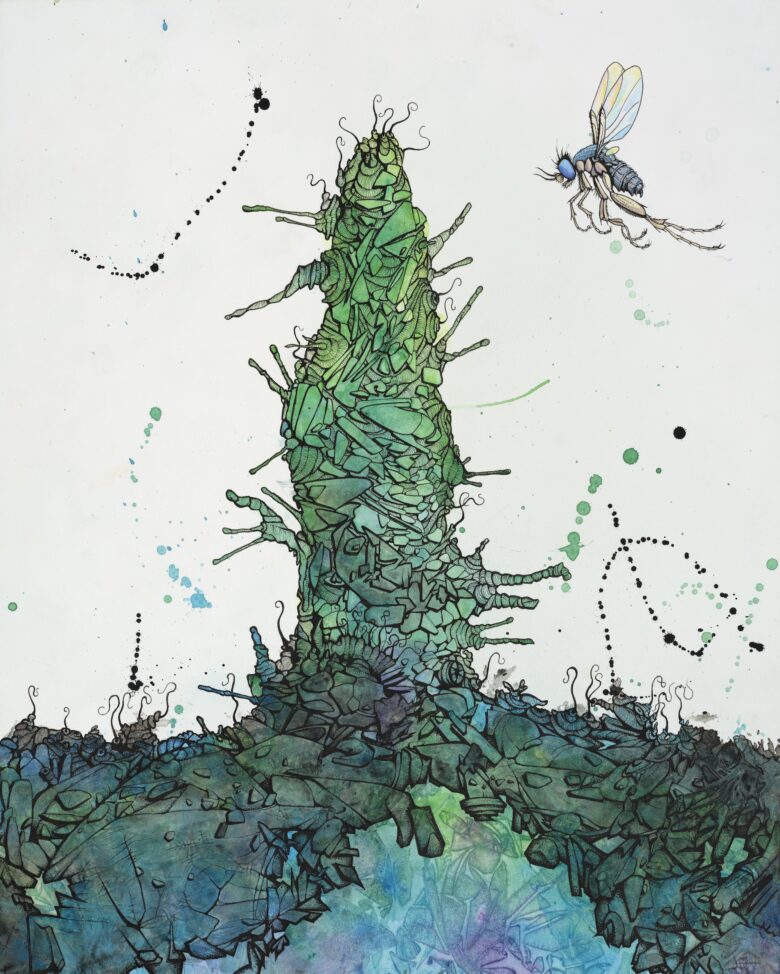
Watercolor and Ink
16 x 20 inches
2021-2024
This piece was created using the decalcomania method.
See Decalcomania.
This is one of the early pieces that I made using the “decalcomania” method. The fly in this painting is a member of the genus, Phora, which commonly shows up in my entomological studies in NW Oregon forests.

About the fly: “Phora “.
Phoridae are the most diverse family of flies (over 4,000 species named so far) and are found all over the world. This family includes the smallest fly species known on Earth (0.4mm long). The inspiration for the fly in this painting is from the 2-3 mm Phora specimens that I’ve seen conducting forest floor biodiversity studies in NW Oregon. I don’t know the name of this particular Phora species. I’m not certain that anyone does. You can see one here in one of my microscope photos.
Phora can fly, but they also rapidly run across surfaces, earning themselves the common name “scuttle flies”. A brief exploration of this family of flies reveals an incredible variety of strange ecological behaviors. Some feed on plants, others on fungi, and others are predators. Some Phorids feed on urban decaying matter, such as in drainpipes and sewers, and can transmit dangerous pathogens. Some feed on human corpses (called “coffin flies”), and are used by forensic anthropologists to estimate the time of death of a corpse. Honestly, though, these flies get so much weirder than that.
Some Phorid species survive by interacting with ants in bizarre ways. Ants, by the way, are dangerous for other insects to interact with. Ants are venomous, and they gang up on other bugs. Some Phorids are ant kleptoparasites, actually living on worker ants’ backs and using their legs to trigger ants to regurgitate food which they feed on. Some have evolved into legless, wingless flies that mimic ant larvae and are actually fed by adult ants. Other Phorid species are parasitoids on ants, injecting their eggs into the bodies of live ants. The larvae will burrow through the ant to its head, where they feed on its brain. The ant remains alive as its entire brain is eaten. Finally these larvae cut through the connections and the ant’s head falls off. Inside, the larvae pupate, eventually bursting out of the severed head as fully-grown flies.
Parasitoid Phorids have also been found inside some honeybees that have died due to colony collapse, bringing into question their potential contribution to the current Colony Collapse Disorder epidemic that is plaguing US honey bee colonies.
There are MANY different species of Phorids, each with their own distinct ecology and approach to survival. Perhaps this painting can serve as a conversation piece and a reminder of the fascinating world of small living things we are surrounded by every day.